Platform Comparison
StoreConnect vs Contentstack
Experience platform, or unified commerce?
Contentstack AXP brings content, first-party data, and AI agents into one platform. But an experience layer still needs a commerce engine, a POS, and a CRM behind it. Here’s how StoreConnect compares when you need all of it working as one system.
- ✓ CMS + Commerce + CRM in One
- ✓ Agentic Foundation
- ✓ Native Salesforce

What does StoreConnect do?
StoreConnect is a unified commerce platform built natively on Salesforce. It brings your website CMS, eCommerce store, Point of Sale, and customer CRM data together into a single source of truth — so there are no separate systems to connect.

What does Contentstack do?
Contentstack AXP is an agentic experience platform combining a headless CMS, a real-time customer data platform, and Agent OS for AI-driven content operations. It manages and personalizes digital experiences; transactional commerce, POS, and CRM come from separate systems.
Key takeaways
StoreConnect is the right choice if you want to:
- Sell, not just publish — run products, carts, checkout, orders, and payments in the same platform that manages your content.
- Keep one system of record so orders, cases, and customer history live in Salesforce rather than being assembled from a CMS, a CDP, and a commerce engine.
- Sell online and in-store with a built-in POS sharing the same catalog, inventory, and customer records as your website.
- Give Agentforce agents transactional data — order status, stock levels, and purchase history already in standard Salesforce objects.
- Reduce vendor count by replacing separate CMS, commerce, POS, and CRM contracts with one Salesforce-native platform.
- Meet commerce-grade compliance with PCI DSS 4.0.1 and HIPAA alongside SOC 2, SOC 3, and ISO 27001:2022.
Contentstack could be a good fit for you if:
- Content operations are your primary problem and you want agentic tooling aimed squarely at authoring, translation, and publishing at scale.
- You already have a commerce engine you intend to keep, and you need a stronger experience layer in front of it.
- You run a composable architecture with the engineering capacity to integrate and maintain several best-of-breed vendors.
- Personalization is the priority and a real-time CDP for behavioral targeting matters more to you than a transactional system of record.
- You have no Point of Sale requirement and operate through digital channels only.
Platform Scope & Unified Commerce
| Capability | StoreConnect | Contentstack |
|---|---|---|
| Content management (CMS) | ✓ Built-in website builder and CMS with approval workflows | ✓ Core product — enterprise headless CMS with structured content and custom workflows |
| Transactional commerce | ✓ Native — products, carts, checkout, orders, and payments in one platform | ⚠ Not included — requires a separate commerce platform behind the experience layer |
| Point of Sale (POS) | ✓ Built-in POS sharing the same catalog and customer data as online | ⚠ Not available — no POS capability |
| CRM system of record | ✓ Salesforce is the system of record for customers, orders, and cases | ⚠ Real-time CDP for first-party profile and behavioral data; not a CRM system of record |
| Inventory & stock management | ✓ Unlimited stock locations, transfers, receipting, and multi-location visibility | ⚠ Not included — handled by the connected commerce platform |
| Single source of truth | ✓ Content, commerce, and customer data unified in one Salesforce org | ⚠ Content and profile data in Contentstack; orders and CRM records in external systems |
Contentstack is a genuinely capable experience platform, and its content tooling is built for enterprise scale. It is not, however, a commerce engine — there is no cart, no order object, and no POS. Building a full commerce operation around it means selecting, integrating, and maintaining separate commerce, POS, and CRM platforms. StoreConnect delivers all of these natively on Salesforce.
Salesforce Compatibility & Data Architecture
| Feature | StoreConnect | Contentstack |
|---|---|---|
| Salesforce native | ✓ Runs entirely within Salesforce — no separate commerce database | ⚠ Independent platform; Salesforce connectivity via API integration or marketplace apps |
| Built-in sync with Salesforce | ✓ Architectural — data is written directly to standard Salesforce objects | ⚠ API-based integration you build and maintain |
| Customer & order history in CRM | ✓ Every order, cart, and POS transaction visible on the Salesforce customer record | ⚠ Requires both a commerce integration and a CRM integration to assemble |
| Customer data model | ✓ Full CRM — accounts, contacts, opportunities, cases, and orders in one model | Real-time CDP — unified profiles and segments for personalization and activation |
| Data ownership | ✓ All commerce and customer data resides in your own Salesforce org | ⚠ Content and profile data stored in Contentstack’s infrastructure |
| Salesforce CPQ compatibility | ✓ Compatible out of the box — no custom configuration required | ⚠ Not applicable — no quoting or pricing engine |
A CDP and a CRM answer different questions. Contentstack’s Data Cloud is built to unify behavioral signals and activate segments for personalization. StoreConnect’s built-in sync writes commerce data straight into Salesforce, so the order, the case, the quote, and the customer live in one model that sales, service, and marketing teams already work in every day.
AI, Agents & Agentic Foundation
| Capability | StoreConnect | Contentstack |
|---|---|---|
| Native AI agents | ✓ Agentforce agents plus the StoreConnect Agentforce Toolkit | ✓ Agent OS included across tiers — no-code agents, brand-aware AI, writing assistance |
| Agentforce compatibility | ✓ Native — commerce data already sits in objects Agentforce can read | ⚠ No native Agentforce support; content and profiles exposed via API |
| Data available to agents | ✓ Orders, products, stock, POS sales, cases, and pipeline in one org | Content entries, assets, and first-party behavioral profiles |
| Transactional actions | ✓ Agents can check stock, look up orders, and act on purchase history | ⚠ Content and workflow actions; transactional actions require external systems |
| Agentic Foundation | ✓ Commerce, CMS, and CRM unified — a complete foundation for agentic commerce | ⚠ Content and experience foundation; commerce and CRM layers added separately |
Both platforms take AI seriously, and Agent OS is a real strength for content teams. The difference is reach. An agent is only as useful as the data it can act on, and a customer asking “where is my order” needs transactional records, not content entries. StoreConnect gives Agentforce agents order status, stock levels, and complete purchase history inside Salesforce — see the StoreConnect Agentforce Toolkit.
Point of Sale & Omnichannel Operations
| Omnichannel Feature | StoreConnect | Contentstack |
|---|---|---|
| Built-in Point of Sale | ✓ Native POS with barcode readers, cash drawers, receipt printers, and card readers | ⚠ No POS capability |
| In-store customer recognition | ✓ POS sales update Salesforce customer records through built-in sync | ⚠ Not applicable — no in-store commerce layer |
| Inventory across channels | ✓ Stock visible and managed across web and physical locations from Salesforce | ⚠ No inventory management — requires separate commerce and POS platforms |
| Cross-channel vouchers & loyalty | ✓ Same voucher code and loyalty points online and in person | ⚠ Not available — no transactional capability |
If you sell in physical locations, Contentstack cannot stand alone — it provides no POS, no inventory, and no transactional layer. StoreConnect’s unified model means an in-store sale and an online sale write to the same Salesforce records, so every team sees the same customer regardless of where the purchase happened.
Licensing, Implementation & Total Cost
| Consideration | StoreConnect | Contentstack |
|---|---|---|
| Vendors required for full commerce | ✓ One — StoreConnect on Salesforce covers CMS, commerce, POS, and CRM | ⚠ Multiple — Contentstack plus a commerce platform, a POS, and a CRM |
| Pricing model | ✓ Per-licence pricing from Boutique to Flagship — view pricing | Free tier available; paid tiers quoted by Contentstack sales |
| Market tier | ✓ Emerging through to enterprise on a single platform | Positioned for mid-market and enterprise digital experience programs |
| Front-end & hosting | ✓ Storefront, templating, and hosting included | ✓ Launch provides integrated MACH-compliant front-end hosting |
| Developer dependency | ✓ Standard Salesforce and web tools; Liquid templating familiar to most developers | ⚠ API-first architecture typically requires front-end developers for build and delivery |
| Integration overhead | ✓ No integration needed between CMS, commerce, POS, and CRM | ⚠ Commerce, POS, and CRM integrations must be built and maintained |
| Ongoing maintenance | ✓ Single platform on the Salesforce upgrade cadence; no API pipelines to maintain | ⚠ Multiple vendor contracts and integrations require ongoing engineering resource |
A Contentstack-based commerce stack usually means three or more vendor relationships, each with its own contract, API surface, and maintenance burden. That can be the right trade for organizations who want to choose every layer themselves. For organizations that would rather not run integration projects at all, StoreConnect consolidates the stack into one Salesforce-native platform. See StoreConnect pricing.
Data Security & Compliance
| Feature | StoreConnect | Contentstack |
|---|---|---|
| ISO 27001 | ✓ ISO/IEC 27001:2022 certified | ✓ ISO 27001 certified |
| SOC reports | ✓ SOC 2 Type I, SOC 2 Type II, and SOC 3 | ✓ SOC 2 Type II; report available from Contentstack on request |
| PCI DSS | ✓ PCI DSS 4.0.1 compliant | ⚠ Not published — payment card data is handled by the connected commerce platform |
| GDPR | ✓ GDPR ready; inherits Salesforce’s globally recognized data protection standards | ✓ GDPR and CCPA support |
| HIPAA | ✓ Available on Emporium and Flagship plans | ✓ Safeguards provided to support HIPAA compliance |
| Data residency | ✓ All commerce and customer data resides in your own Salesforce org | ⚠ Content and profile data stored in Contentstack’s infrastructure |
| Disaster recovery | ✓ Full store rebuild from your Salesforce org within hours, no third-party dependencies | ⚠ Platform-managed; recovery of a full commerce stack spans multiple vendors |
| Dedicated infrastructure | ✓ Flagship plans include dedicated web and database servers | Enterprise-tier options available |
Both platforms hold credible enterprise certifications, and Contentstack’s security posture is well documented. The distinction is scope: StoreConnect’s certifications cover a full commerce stack including payments, and every commerce and customer record stays in your own Salesforce org rather than a vendor’s infrastructure. For more information see the StoreConnect Trust Center.
Which is the right choice for you?
When StoreConnect is the right choice
StoreConnect is purpose-built for businesses that want commerce, content, and customer data unified on Salesforce. It’s the right fit if:
- You already use Salesforce and want CMS, eCommerce, and POS inside your CRM
- You need a true single source of truth — consolidated, not connected
- You sell online and in physical locations and need unified inventory and customer data
- You want Agentforce agents acting on complete transactional data, not just content
- You want to reduce vendor count and remove ongoing integration overhead
- You require PCI DSS 4.0.1 or HIPAA compliance for your commerce operations
When Contentstack may be the right choice
Contentstack is a strong experience platform for content-led digital programs. It could be a good fit if:
- Content operations at scale are your primary requirement, across many channels and locales
- You have a composable architecture and a team to integrate commerce and CRM separately
- Your commerce engine is already chosen and you want a stronger experience layer in front of it
- Behavioral personalization through a real-time CDP is a higher priority than a transactional system of record
- You operate through digital channels only, with no POS requirement
Download the FREE Guide
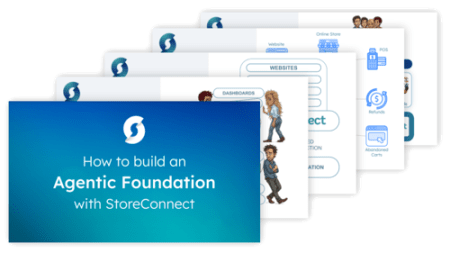
How to build an Agentic Foundation with StoreConnect
Create an Agentic Foundation ready for Agentforce.
Download FREE Guide