Platform Comparison
StoreConnect vs Adobe Commerce
Which platform is right for you?
Choosing the wrong eCommerce platform can mean years of costly integrations and siloed data. Here’s how StoreConnect compares to Adobe Commerce — so you can make the right call from day one.
- ✓ Commerce on Salesforce
- ✓ Agentic Foundation
- ✓ No Integration Tax

What does StoreConnect do?
StoreConnect is a complete commerce platform built natively on Salesforce. It enables businesses to run their website, eCommerce store, Point of Sale, and all customer data from a single source of truth — inside Salesforce — without any third-party integration layer.

What does Adobe Commerce do?
Adobe Commerce (formerly Magento) is a standalone eCommerce platform available as a cloud service (SaaS) or dedicated cloud (PaaS). It requires integration with external CRM systems — such as Salesforce — to build a connected customer view across your business.
Key takeaways
StoreConnect is the right choice if you want to:
- You use Salesforce and want to keep all customer, order, and inventory data inside Salesforce to create a true Agentic platform.
- Unify B2B and B2C commerce from a single Salesforce dataset without stacking separate platforms or middleware layers.
- Enable Agentforce AI from day one — your commerce data is already in Salesforce, so AI agents have an immediate, complete foundation to work from.
- Include built-in Point of Sale that instantly syncs in-store and online sales into your Salesforce CRM records.
- Reduce total cost of ownership by using industry-standard web tools rather than proprietary commerce frameworks requiring specialist developers.
- Industry-leading security certifications with enterprise-grade data residency, architecture, recovery, and isolation.
Adobe Commerce could be a good fit if:
- You are not a Salesforce customer and want a standalone, enterprise-grade storefront independent of any specific CRM platform.
- You have dedicated integration resources to build and maintain connectors between Adobe Commerce and your CRM, ERP, and other back-office systems.
- You require Adobe Experience Cloud integration — such as Adobe Analytics, Target, or Marketo — as your primary personalisation and marketing stack.
- You are comfortable with custom quote-based pricing and implementation projects typical of Adobe Commerce enterprise deployments.
- You don’t need a built-in POS and are content sourcing a separate in-store solution and integrating it externally.
Salesforce Compatibility & Data Architecture
| Feature | StoreConnect | Adobe Commerce |
|---|---|---|
| Salesforce CRM integration | ✓ Native — built directly on Salesforce, zero integration required | ⚠ Requires external connectors, APIs, or middleware (e.g. integration starter kits) |
| Core Salesforce cloud objects | ✓ Saves directly to standard Salesforce core objects | ⚠ Isolated database requiring ongoing data synchronisation |
| Experience Cloud licenses | ✓ Works without additional Experience Cloud licenses | Not applicable |
| Salesforce CPQ compatibility | ✓ Compatible out of the box | ⚠ Requires custom integration or middleware |
| AI & Agentforce readiness | ✓ Native Agentic Foundation — Agentforce accesses live commerce data immediately | ⚠ Adobe AI tools (Firefly, Brand Concierge) require separate Adobe Experience Cloud stack |
| Single customer record | ✓ One record across all channels — online, POS, and CRM — in Salesforce | ⚠ Customer data split across Adobe Commerce and your CRM; sync required to unify |
StoreConnect eliminates data integrity issues entirely. Every purchase, customer detail, and inventory adjustment updates instantly inside Salesforce — making it the ultimate Agentic Foundation ready for Agentforce. Adobe Commerce operates as an isolated system, requiring integration starter kits or custom connectors to keep your CRM and storefront data aligned — adding ongoing maintenance overhead.
Implementation & Total Cost of Ownership
| Metric | StoreConnect | Adobe Commerce |
|---|---|---|
| Pricing model | ✓ Transparent, per-licence pricing suited from budgets to enterprise | ⚠ Custom quote-based pricing — contact Adobe sales for SaaS, PaaS, or Optimizer tiers |
| Data architecture footprint | ✓ Single source of truth inside Salesforce | Separate commerce database plus your CRM — two systems to keep in sync |
| API customisation overhead | ✓ Zero API setup required for CRM alignment | ⚠ Integration starter kits provided, but custom build and ongoing maintenance required |
| Developer ecosystem | ✓ Industry-standard web development tools — broad talent pool | ⚠ Proprietary Magento/Adobe Commerce framework requiring specialist commerce developers |
| Add-on costs | ✓ Core features included; Salesforce AppExchange for extensions | ⚠ Key features (payment services, order management, asset management) are paid add-ons |
| Upgrade management | ✓ Inherits Salesforce’s automatic release cycle — no manual upgrades | SaaS tier: automatic updates; PaaS tier: merchant-managed upgrade cycles and testing |
Adobe Commerce’s enterprise-grade feature set comes with corresponding enterprise-grade complexity and cost. Key capabilities — including payment services, advanced order management, and asset management — are available as paid add-ons, and custom integration with your CRM is expected. StoreConnect’s all-inclusive model on Salesforce lets organisations redirect engineering budgets from API maintenance toward better customer experiences.
Use Cases & Global Commerce
| Capability | StoreConnect | Adobe Commerce |
|---|---|---|
| B2B / B2C / B2B2C sales | ✓ Supported natively across all commerce structures in one Salesforce org | B2C and B2B supported; B2B features (company accounts, quoting, credit) available on SaaS and PaaS tiers |
| Multi-region / multi-site | ✓ Single unified dataset for multi-currency and multi-language operations | Multi-site architecture supported; managed from single admin, but adds configuration complexity |
| Payment routing by zone | ✓ Unique payment providers per zone natively supported | ⚠ Adobe Payment Services available as paid add-on; third-party providers via extensions |
| Content management | ✓ Built-in CMS with approval workflows and live page editor | ⚠ Content authoring tools available as add-on on certain tiers; requires separate CMS setup |
| Subscriptions & recurring billing | ✓ Integrated natively into standard checkout | ⚠ Requires third-party extension or custom development |
| Nonprofit & donation support | ✓ Native pay-what-you-want and preset giving; Salesforce NPSP compatible | ⚠ Not a native capability; requires third-party extension or custom development |
StoreConnect handles complex B2B, B2C, and cross-border configurations from a single Salesforce dataset. Paired with the Agentforce Toolkit, your global storefront gains intelligence that contextualises customer interactions across regions automatically. Adobe Commerce’s multi-site capabilities are strong, but each capability layer — content authoring, payment services, order management — typically involves additional licensing and integration work.
AI & Personalisation Capabilities
| Capability | StoreConnect | Adobe Commerce |
|---|---|---|
| AI product recommendations | ✓ Powered by Agentforce and Salesforce Einstein from your live CRM data | 13 types of AI-powered product recommendations via Adobe Sensei — separate Adobe stack |
| AI semantic search | ✓ Salesforce search powered by Einstein; no separate commerce search layer required | AI-powered semantic search included in Adobe Commerce catalog service |
| Agentic commerce | ✓ Native Agentic Foundation — Agentforce agents operate directly on live Salesforce commerce data | ⚠ Agentic protocols supported (Google, OpenAI); requires Adobe LLM Optimizer and Brand Concierge — separate products |
| Personalisation data source | ✓ Your complete Salesforce CRM — purchase history, service cases, and loyalty data unified | ⚠ Requires integration with Adobe Real-Time CDP or Adobe Experience Cloud for cross-channel profiles |
| Generative content creation | ✓ Agentforce and Einstein GenAI available within your existing Salesforce environment | Adobe Firefly generative AI for product images and content — requires Adobe Creative Cloud stack |
Both platforms have genuine AI capabilities. The key difference is the data foundation: StoreConnect’s AI is powered by your complete, live Salesforce CRM — customers’ full purchase history, service cases, and loyalty data are all available to Agentforce with zero data movement. Adobe Commerce’s AI features are strong, but depend on the broader Adobe Experience Cloud stack, which typically requires additional licensing and integration work to unlock personalisation at the same depth.
Point of Sale & Omnichannel Operations
| Omnichannel Feature | StoreConnect | Adobe Commerce |
|---|---|---|
| Built-in POS system | ✓ Included — POS uses the same product data and images as online store | ⚠ No native POS; requires third-party POS integration |
| Real-time CRM sync from POS | ✓ Instant — in-store sales immediately update Salesforce customer records | ⚠ No native CRM; requires integration from POS to Adobe Commerce and then to your CRM |
| Inventory management | ✓ View and request multi-location stock directly from POS | Multi-inventory location support available; order management via IBM Sterling add-on |
| Cross-channel vouchers | ✓ Same voucher code redeemable online and in-person from a single Salesforce record | ⚠ Promotion management built in online; cross-channel POS voucher unification requires integration |
| Click & Collect (BOPIS) | ✓ Native click and collect direct to included POS | ⚠ Click and collect available but requires POS and order management integrations |
StoreConnect’s unified data model means in-store sales register instantly in Salesforce customer records — creating an Agentic Foundation where AI agents can support customers based on their complete online and offline purchase history. Adobe Commerce does not include a native POS system, requiring businesses to source, integrate, and maintain a separate in-store solution alongside their Adobe Commerce deployment.
Data Security & Compliance
| Feature | StoreConnect | Adobe Commerce |
|---|---|---|
| PCI DSS | ✓ PCI DSS 4.0.1 compliant | PCI DSS Level 1 Solution Provider certified |
| SOC Reports | ✓ SOC 2 Type II and SOC 3 | SOC 2 Type 2 and SOC 3 (Security, Availability & Confidentiality) |
| ISO 27001 | ✓ ISO/IEC 27001:2022 certified | ISO 27001:2022 certified (Adobe Experience Cloud) |
| GDPR / Privacy | ✓ Inherits Salesforce’s globally recognised privacy and data protection standards | TrustArc GDPR Privacy Practices validation; merchant responsible for compliance configuration |
| HIPAA | ✓ HIPAA certified | HIPAA-ready available as paid add-on on Cloud tier |
| Data residency | ✓ All data resides in your own Salesforce org — you own and control it completely | ⚠ Data hosted in Adobe’s multi-tenant or dedicated cloud infrastructure; data residency options vary by tier |
| Data architecture | ✓ Single source of truth inside Salesforce; no duplicate data on third-party systems | ⚠ Separate commerce database from your CRM — requires ongoing data synchronisation |
| Disaster recovery | ✓ Full store rebuild from your Salesforce org — no third-party dependency | Adobe-managed business continuity and disaster recovery (ISO 22301:2019 certified) |
Both platforms carry strong enterprise security credentials. The structural difference is data architecture: with StoreConnect, your commerce data lives in your own Salesforce org — not a vendor’s shared infrastructure — giving you full ownership, control, and the ability to rebuild your entire store from Salesforce in the event of an issue. For more information see the StoreConnect Trust Center.
Which is the right choice for you?
When StoreConnect is the right choice
StoreConnect is purpose-built for Salesforce environments. It’s the right fit if:
- You already use Salesforce and want commerce natively inside your CRM
- You need a true single source of truth across your website, eCommerce, and POS
- You run B2B, B2C, or multi-region operations from one unified dataset
- You want AI agents powered by Agentforce with zero custom data connectors
- You need a built-in POS that instantly syncs with your Salesforce CRM
- You want predictable licensing without stacking paid add-ons for core features
When Adobe Commerce may be the right choice
Adobe Commerce may suit your business if:
- You are not a Salesforce customer and want an enterprise storefront platform independent of any specific CRM
- You are already deeply embedded in Adobe Experience Cloud and want native integration with Adobe Analytics, Target, and Marketo
- You have dedicated integration and development resources for ongoing CRM and back-office connector maintenance
- You require Magento’s extensive extension marketplace for highly custom commerce configurations
- You don’t need a built-in POS and manage in-store separately
Download the FREE Guide
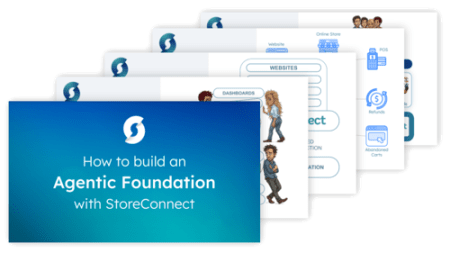
How to build an Agentic Foundation with StoreConnect
Create an Agentic Foundation ready for Agentforce.
Download FREE Guide