Platform Comparison
StoreConnect vs Webflow
Which platform is right for you?
Webflow is a powerful visual development platform — but when your business needs commerce, POS, and a unified CRM, the gap becomes critical. Here’s how the two compare.
- ✓ Commerce on Salesforce
- ✓ CMS + CRM in one
- ✓ Agentic Foundation

What does StoreConnect do?
StoreConnect is a complete commerce platform built natively on Salesforce. It unifies your website, eCommerce store, Point of Sale, CMS, and customer data inside a single Salesforce org — eliminating the gap between your CRM and your customer-facing channels.

What does Webflow do?
Webflow is a visual web design and CMS platform that allows designers and developers to build highly customised, responsive websites without writing code. It includes limited eCommerce capabilities and has no native CRM, POS, or Salesforce integration.
Key takeaways
StoreConnect could be a good fit if you want to:
- Unify your CMS and CRM inside a single Salesforce org — so every page visit, purchase, and support ticket connects to one customer record.
- Run full eCommerce natively — products, orders, subscriptions, B2B pricing, and checkout — without third-party plugins.
- Operate a Point of Sale with in-store transactions updating Salesforce customer records through built-in sync.
- Build an Agentic Foundation so Agentforce AI agents can act on complete, structured commerce data without custom connectors.
- Manage B2B, B2C, and multi-region commerce from one unified dataset, at any scale.
Webflow could be a good fit if you:
- Need a visually outstanding marketing site with pixel-perfect design control and rich animations — without deep eCommerce requirements.
- Have a small product catalogue and can accept a separate CRM system outside of your website platform.
- Don’t rely on Salesforce and are comfortable managing your commerce data in an isolated system.
- Can use Zapier integrations to connect order data to other tools, and accept the ongoing maintenance that entails.
- Have no in-person selling requirements and no need for an integrated POS system.
eCommerce Capabilities
| Feature | StoreConnect | Webflow |
|---|---|---|
| eCommerce included | ✓ Native — full commerce built into the platform | ⚠ Separate add-on eCommerce plan required (Standard $29/mo+) |
| Product catalogue size | ✓ Unlimited products and variants in Salesforce | ⚠ Up to 15,000 items on Advanced plan; lower tiers are limited |
| B2B / B2C / B2B2C | ✓ Supported natively across all selling models | No native B2B commerce capability |
| Subscriptions & recurring billing | ✓ Native subscription and recurring payment support | Not natively supported — requires third-party integration |
| Donation & nonprofit checkout | ✓ Native pay-what-you-want and preset giving amounts | Not natively supported |
| Payment gateway flexibility | ✓ Multiple providers per region; no transaction fees to platform | ⚠ Stripe, PayPal, and Apple Pay; 2% transaction fee on Standard plan |
| Multi-currency & localisation | ✓ Single dataset supporting multi-currency and multi-language | ⚠ Localisation available as a paid add-on; no native multi-currency commerce |
Webflow’s eCommerce is an add-on designed for small product catalogues — it lacks native B2B pricing, subscriptions, and multi-currency commerce. StoreConnect delivers a complete commerce engine natively, handling the full spectrum of B2C, B2B, and nonprofit selling models from a single Salesforce-connected platform.
CMS & CRM Unification
| Capability | StoreConnect | Webflow |
|---|---|---|
| CRM integration | ✓ Runs natively on Salesforce — CMS and CRM are one system | No native CRM; requires external integration via Zapier or API |
| Customer data architecture | ✓ Single source of truth — one record per customer across all channels | ⚠ Website data siloed from CRM; requires ongoing sync to align |
| Salesforce built-in sync | ✓ All commerce data written directly to Salesforce objects | Not applicable — Webflow has no Salesforce connection |
| Order history in CRM | ✓ Every purchase visible within the Salesforce customer record | ⚠ Order data lives in Webflow; must be exported or synced externally |
| Agentforce AI readiness | ✓ Native Agentic Foundation — structured data ready for AI agents | No Salesforce Agentforce compatibility without custom development |
| CMS content approval workflows | ✓ Built-in content workflows with Salesforce-driven approvals | ⚠ Publishing workflows available on Team/Enterprise plans only |
In the agentic era, businesses need their CMS and CRM to speak the same language. Webflow is an excellent CMS — but it operates entirely separately from your customer relationship data. StoreConnect consolidates both into Salesforce, creating a single source of truth where every page view, purchase, and service interaction enriches the same customer record. This is the foundation that enables Agentforce to act intelligently across every customer touchpoint.
Point of Sale & Omnichannel Operations
| Omnichannel Feature | StoreConnect | Webflow |
|---|---|---|
| Point of Sale (POS) | ✓ Built-in POS — same product data as online store | No POS capability — in-person selling not supported |
| In-store to CRM sync | ✓ POS transactions update Salesforce records via built-in sync | Not applicable |
| Inventory management | ✓ Multi-location stock visible and requestable from POS | No inventory management for in-store operations |
| Cross-channel vouchers | ✓ Same voucher code redeemable online and in-person | Not applicable — no in-person channel |
| Unified order history | ✓ Online and in-store orders consolidated in one Salesforce record | Online orders only; no omnichannel view |
Webflow has no Point of Sale capability. For businesses that sell in-person as well as online — whether in retail, events, or field sales — StoreConnect is the only choice that unifies both channels inside Salesforce. In-store transactions are immediately visible in the customer record, powering AI-driven service and personalisation across every interaction.
Design & Website Capabilities
| Design Feature | StoreConnect | Webflow |
|---|---|---|
| Visual design control | ✓ Full HTML/CSS/JS control for complete design freedom | Industry-leading visual canvas with pixel-perfect design tools |
| No-code page building | ✓ Drag-and-drop page builder included | Best-in-class no-code visual builder with GSAP animations |
| Custom animations & interactions | Standard interaction support | Advanced interactions and GSAP-powered animation timeline |
| CMS-driven content | ✓ CMS content driven directly from Salesforce data objects | Robust CMS with up to 20,000 items; headless CMS API available |
| SEO tooling | ✓ Built-in SEO management with meta, schema, and redirects | Strong SEO tooling including AEO (AI engine optimisation) features |
| Figma integration | Standard design workflow | Native Figma-to-Webflow import (Labs feature) |
Webflow is genuinely outstanding for visual design — it’s one of the most powerful no-code website builders available. StoreConnect matches Webflow on design flexibility through full HTML/CSS/JS access, and surpasses it in commerce: every design decision in StoreConnect is backed by live Salesforce data, meaning your website, your store, and your customer relationships all work as one.
Pricing & Total Cost of Ownership
| Cost Factor | StoreConnect | Webflow |
|---|---|---|
| Pricing model | ✓ Per-licence pricing from Boutique to Flagship — view pricing | Site plans from $15/mo; eCommerce plans from $29/mo billed annually |
| eCommerce included | ✓ Included natively in all plans | ⚠ Separate eCommerce plan required — additional cost on top of site plan |
| Transaction fees | ✓ No platform transaction fees | ⚠ 2% transaction fee on Standard eCommerce plan; waived on Plus and above |
| CRM integration cost | ✓ Included — runs natively on your existing Salesforce org | ⚠ Requires Zapier, API integration, or third-party middleware — ongoing cost |
| POS system cost | ✓ Included natively — no additional POS licence required | Not available — would require a separate POS platform |
| Enterprise team plan | ✓ Enterprise-grade Flagship tier with dedicated infrastructure | ⚠ Enterprise plan available at custom quote; Team platform plan from $2,500/mo |
Webflow’s entry price looks attractive — but once you add a separate eCommerce plan, a CRM integration layer, and a POS solution, the total cost of ownership grows considerably. StoreConnect consolidates all of these into a single platform on Salesforce, reducing vendor complexity and ongoing integration maintenance costs.
Data Security & Compliance
| Feature | StoreConnect | Webflow |
|---|---|---|
| PCI DSS | ✓ PCI DSS 4.0.1 compliant | PCI DSS compliant |
| SOC 2 Type II | ✓ SOC 2 Type II certified | SOC 2 Type II certified |
| ISO 27001 | ✓ ISO/IEC 27001:2022 certified | ISO/IEC 27001:2022 certified |
| HIPAA | ✓ HIPAA compliant | ⚠ Not listed as HIPAA compliant — check with Webflow for current status |
| SOC 3 | ✓ SOC 3 certified | ⚠ SOC 1 Type 2 certified; SOC 3 not listed |
| GDPR | ✓ Inherits Salesforce’s globally recognised privacy and data protection standards | GDPR compliant; EU-US and Swiss-US Data Privacy Framework certified |
| Data residency | ✓ All data resides in your own Salesforce org — you own and control it | ⚠ Stored in Webflow’s AWS-hosted infrastructure; limited merchant control over residency |
| Data architecture | ✓ Single source of truth inside Salesforce — no duplicate data on third-party systems | ⚠ Isolated CMS database separate from any CRM, requiring ongoing data syncing |
Both platforms hold strong security credentials. The key difference for enterprise buyers is data ownership: StoreConnect stores all data inside your own Salesforce org — you are not dependent on a third-party vendor’s infrastructure for your customer records. For more information see the StoreConnect Trust Center.
Which is the right choice for you?
When StoreConnect is the right choice
StoreConnect is purpose-built for businesses that need commerce and CRM to work as one. It’s the right fit if:
- You already use Salesforce and want commerce natively inside your CRM
- You need to unify your website, eCommerce, POS, and customer data in one platform
- You run B2B, B2C, or multi-region operations that require a single source of truth
- You want AI agents powered by Agentforce with no custom data connectors needed
- You sell both online and in-person and need a unified omnichannel view of each customer
When Webflow could be a good fit
Webflow works well for design-led marketing sites. It may suit you if:
- Your primary need is a beautifully designed marketing or content site with minimal eCommerce
- You have a small physical product catalogue and no B2B or subscription requirements
- You don’t use Salesforce and are managing your CRM in a separate system
- You have no in-person selling requirements and no need for POS integration
- You are comfortable connecting commerce data to your CRM via third-party integration tools
Download the FREE Guide
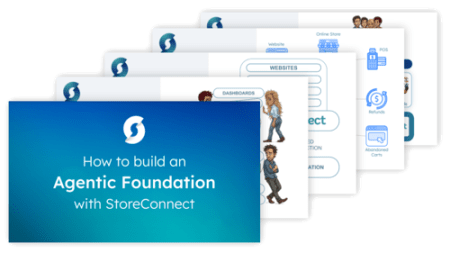
How to build an Agentic Foundation with StoreConnect
Create an Agentic Foundation ready for Agentforce.
Download FREE Guide