Every small storefront rule is becoming an Apex project in someone's backlog
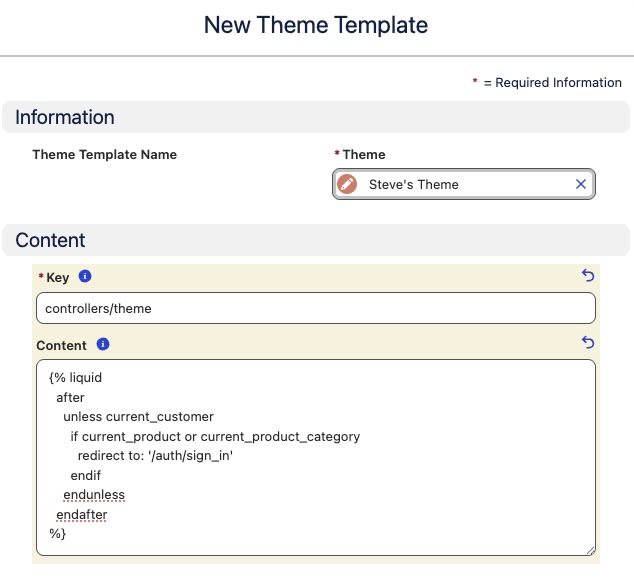
“Redirect wholesale customers to their own catalog.” “Capture a PO number on this form.” “Add the free sample automatically when the cart passes $100.” These are small, sensible business rules. On many stacks, each one becomes a custom code project, written in Salesforce, tested, deployed and then maintained forever. So most of them never get built.
The storeconnect-controllers skill teaches AI agents how to run this kind of server-side logic in the storefront itself, using Liquid controllers, without Apex.
Get the skills plugin or watch the full demo.
Custom code work is eating the time your IT team doesn’t have
IT teams are already stretched. MuleSoft’s 2026 Connectivity Benchmark found IT teams spend an average of 36% of their time designing, building and testing custom integrations between systems1, and Salesforce’s State of IT research found project requests surged 18% year over year2. A request for a storefront redirect is unlikely to jump that queue.
Liquid controllers are the storefront-side alternative to Apex for request-time logic. A controller is a theme template that runs around the platform’s own handling of a request, before the action, when the response is about to be sent and as the final step3. The skill teaches an agent to use them for access gating and redirects, capturing extra form fields, cart automation, injecting data for the page and calling an external service during a render.
Server-side logic written from guesswork breaks quietly
Controllers only run when their key matches a registered controller and action pair3. An agent that doesn’t know that rule writes a controller that never runs, and nobody notices until a business rule quietly fails to apply. Stack Overflow’s 2025 survey found 45% of developers say debugging AI-generated code is more time-consuming4.
The skill spells out the registered key rule, the action tags available and how to intercept form submissions, so the agent writes controllers that actually fire.
Automated writes need safety rules, or they create bad data
Server-side logic that updates records is powerful and risky. A controller that writes the wrong thing on every page view multiplies a mistake across every visitor. Gartner estimates poor data quality costs organizations an average of $12.9 million a year5. The skill includes safety rules for controller-driven writes, so automation stays within safe limits.
Ship the business rules that never made it out of the backlog
Small rules shouldn’t need big projects.
Get the skills plugin. The controllers skill installs with the full StoreConnect catalog for your AI tool, for any storefront behavior that needs to run on the server without Apex.
Watch the full demo. CEO Mikel Lindsaar shows how an agent builds on a real store, and how changes are reviewed before they go live.
References
-
MuleSoft, “Agentic transformation reaches new heights: 2026 Connectivity Benchmark Report insights.” ↩
-
Salesforce, “State of IT, 4th edition: AI and app development.” ↩
-
StoreConnect, “StoreConnect AI” GitHub repository (README, skills and provider packages). ↩ ↩2
-
Gartner, “Data quality: Why it matters and how to achieve it.” ↩