Amart's shoppers move between screen and store. Now its systems do too.
A furniture shopper rarely buys in one place. They browse a sofa on their phone at night, test it in store on the weekend and settle the details days later. When the website and the stores run on separate systems, every one of those handoffs is a chance to lose the sale.
Amart Furniture has closed that gap. Its website and 900 point of sale terminals across 63 stores in Australia now run on StoreConnect, inside the Salesforce platform Amart already uses. The stores started trading on the new point of sale in April 2026, and the website followed in October.1
“Anyone who has replatformed a national retail website knows it’s never just a tech project. It’s a giant business transformation.”
— Taylor Murray, GM - Customer, Amart
Your shoppers move between channels, but their carts don’t
Furniture is a researched purchase. In a 2025 survey of 9,000 US consumers, 63% said they look online first for ideas, yet 85% to 90% still consult sales staff before they buy.2 Across specialty retail, more than two-thirds of consumers now use at least two channels before completing a purchase.3
That journey breaks when the website and the store keep separate carts. The shopper who planned a living room at home starts again at the counter, and the salesperson can’t see what was chosen online. Manhattan Associates’ 2026 benchmark rated only 7% of specialty retailers as unified commerce leaders, and found those leaders achieve twice the revenue growth of the retailers that lag.3
At Amart, one cart now follows the shopper. A cart started at home can be completed in store, and the back office team can edit that same live cart online when a customer calls for help. The point of sale and the website share one catalog, one set of prices and one customer record in Salesforce, so there is no handoff to drop.
You can’t see how the whole business is trading
When store sales sit in one system and online orders in another, the trading picture arrives late and in pieces. Someone exports, reconciles and cross-checks before anyone can say how a weekend promotion landed. The same 2026 benchmark found retailers with live inventory intelligence reported inventory turns up to 50% higher in North America.3
Amart now trades from one set of numbers. Every sale, whether it’s rung up on a store tablet or placed on the website, is recorded in the same Salesforce org through StoreConnect’s built-in sync. There’s no second system to reconcile, so a dashboard of the whole business is just a Salesforce dashboard.
In the first days after the website went live, one Amart employee built dashboards showing live sales coming through the platform. “It’s exciting to have this level of visibility at our fingertips,” she said.
A slow site leaks sales a tenth of a second at a time
Speed is revenue. A study by Deloitte Digital for Google found that a 0.1 second improvement in mobile site speed lifted retail conversion rates by 8.4% and average spend by 9.2%.4 A slow, hard-to-find site loses shoppers before they ever reach a store.
Amart’s new site scores 99 for performance and 100 for SEO in Google Lighthouse audits, up from 73 and 54 on its previous site.5 Accessibility rose from 75 to 100, which means more shoppers can browse and buy without barriers.
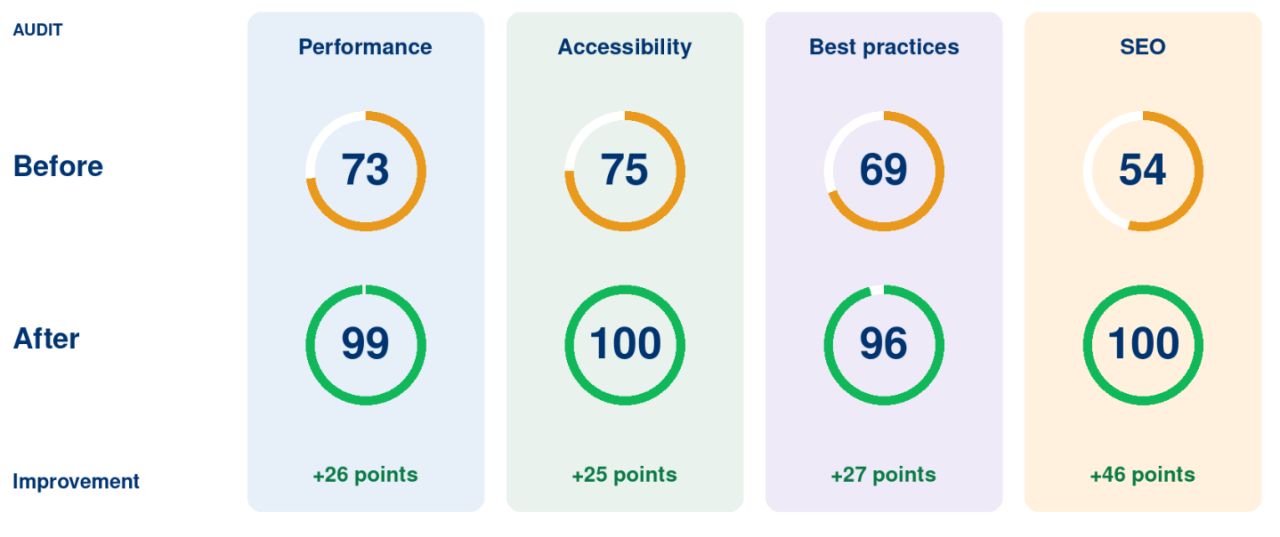
“These aren’t vanity scores. A faster, more accessible and more discoverable site means a better experience for every customer.”
— Taylor Murray, GM - Customer, Amart
Every new idea waits on another integration
Running a point of sale, a website and a CRM as three systems means every change touches all three. A new promotion, a price update or a delivery option has to be built, mapped and tested across each connection before it reaches a shopper. Amart’s team described the work of untangling this as “rebuilding integrations, rethinking how product, pricing and content flow through the business”.6
StoreConnect removes the middle layer. It runs inside Salesforce, so products, prices, customers, carts and orders are Salesforce records rather than copies held in a separate commerce database. Amart’s IT team and its implementation partner SLEEQ now extend one platform instead of maintaining the joins between three.
Payments across 900 terminals also need to be secure. StoreConnect holds SOC 2 Type II, ISO 27001:2022 and PCI DSS 4.0.1 certification, with details in the StoreConnect Trust Center.
Every month on split systems is another month of lost handoffs
Shoppers already move freely between screen and store. Retailers whose systems can’t follow them keep paying for it in abandoned carts, late reports and slow pages. For Amart, go-live was the turning point rather than the finish line.
“Go-live isn’t the finish line. It’s the starting point. Now we can move faster, test more, personalise better and keep raising the bar on the customer experience.”
— Taylor Murray, GM - Customer, Amart
Book a demo to see a unified cart, store and online sales in one place, and dashboards built on the Salesforce data you already have.
See pricing to understand what running your website and point of sale on one platform costs for a business your size.
References
-
Amart deployment details (stores, terminals, unified cart and go-live dates), StoreConnect, internal source. ↩
-
The digital furniture index: how Americans buy now, HomeByMe (Dassault Systèmes) with IPEA, Prodege and Catalyse Research, 2025. ↩
-
Manhattan Associates: Only 7% of retailers reach unified commerce maturity, Digital Commerce 360, March 27, 2026, reporting the 2026 Global Unified Commerce Benchmark by Manhattan Associates and Incisiv. ↩ ↩2 ↩3
-
Milliseconds make millions, Google, 55 and Deloitte Digital, published on web.dev. ↩
-
Amart Google Lighthouse audit, before and after go-live, shared by Taylor Murray on LinkedIn, October 2026. ↩
-
Taylor Murray, “We did it. Amart is officially live on StoreConnect”, LinkedIn, October 2026. ↩