Why I built StoreConnect
In my last post, AI agents can talk about anything, but do you want them to?, I talked about how your AI is only as good as the data it’s grounded in. But there is a reason most companies cannot ground their AI: they are buried under a spaghetti pile of integrations.
I didn’t build StoreConnect because the world needed another eCommerce platform. I built it because I was tired of watching CEOs ask the same frustrated question: Why can’t our systems just talk to each other?
The standard response is to build a bridge. You build one custom link from your ERP to your sales tools. Then you build another for accounts. Then another for the website, and yet another for the POS in your physical stores.
Before you know it, you’re not running a business; you’re managing a fragile spiderweb.
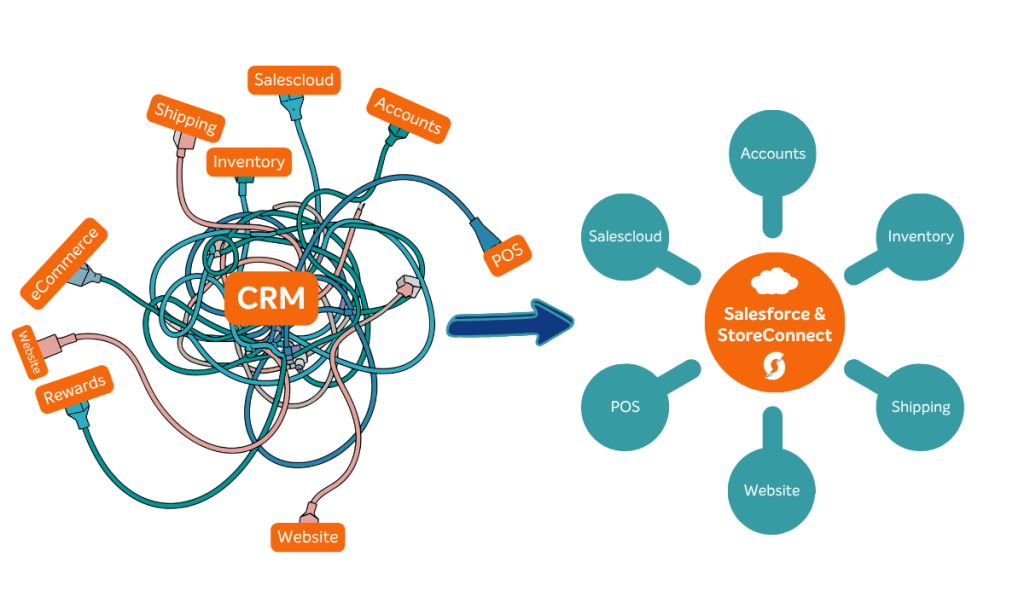
The problem with this spaghetti architecture isn’t just the eye-watering cost, it’s the risk. When you have four or five different bridges connecting your business, one can break in total silence.
I have seen businesses realize, two hours too late, that they have lost thousands in sales because a single integration snapped and nobody noticed. The website looked fine, but the data was stuck in a sync trap.
This is exactly why I built StoreConnect. I knew there was a more resilient way to scale.
By leveraging Salesforce as your single source of truth, you stop building dozens of fragile bridges. Because StoreConnect is built natively on Salesforce, it isn’t integrated with your CRM, it IS your CRM. This means anything that communicates with Salesforce, by definition, already communicates with your eCommerce, your POS and your inventory.
Instead of managing a mess of integrations, you manage just one.
What does this mean for you as a leader? It means business continuity. If that single link ever has an issue, you know immediately because every department is affected at once. There’s no guesswork and no silent failures.
Simplifying your integrations isn’t just a technical cleanup task; it is a strategic move for resiliency. When you stop worrying about whether your systems are talking, you can start focusing on how your business is growing.
Stop managing a spiderweb of data. Book a demo with the StoreConnect team to see how we can simplify your stack.