What Salesforce's latest research means for StoreConnect users
Salesforce’s seventh annual State of the AI Connected Customer report, drawn from more than 16,500 global respondents, lands a clear message for businesses: AI is accelerating customer expectations faster than customer trust.
For commerce operators building on Salesforce, those findings are not abstract. They are a checklist.
Trust is eroding at the worst possible moment
The headline statistic is sobering. Only 42% of customers now trust businesses to use AI ethically, down sharply from 58% in 2023. For StoreConnect merchants, this erosion has a direct commercial consequence.
Further, 71% of customers report being more protective of their personal data than ever before. Customers feel that companies are moving faster than they are moving responsibly.
That gap has not gone unnoticed at Salesforce. Trust is the company’s stated number one value and in the AI era that commitment is structural rather than aspirational.
The Einstein Trust Layer sits at the core of the platform, preventing data leakage and ensuring that AI operates within clear ethical and privacy boundaries. For merchants, that means the system managing customer data and powering AI-driven experiences is the same system built to protect both.
Transparency about how preferences are stored and used is no longer a nice-to-have feature. 42% of customers say transparency into how AI is used is the single biggest factor that would increase their trust.
Personalization is working, but only half the equation is complete
One of the report’s more striking reversals is the jump in perceived personalization: 73% of customers in 2024 feel treated as unique individuals, up from just 39% in 2023. That is significant progress. However, only 49% feel that brands use their data in a way that benefits them, down from 60% in 2022.
The gap between those two numbers is where StoreConnect operates.
The platform sits inside Salesforce CRM, which means the customer data powering personalization is the same data used for service, marketing and sales. The question for merchants is not whether they have the data. It is whether customers feel the exchange is fair.
Trust and experience are loyalty levers just as powerful as price. The report shows that 65% of customers stopped buying from a brand because of high prices, but 43% stopped because of poor customer service.
If your storefront automates poorly, without disclosure or a clear path back to a human, then you risk landing in that 43%.
AI agents are coming and consumers are not yet ready
The report’s third chapter is where things get interesting for agentic commerce. Autonomous AI agents, capable of answering questions, taking action and completing tasks on a customer’s behalf, are already in commercial deployment.
Business buyers are considerably more open to them: nearly half would work with an AI agent for efficiency. But only around one-third of consumers feel the same.
Even more revealing is what customers do and do not want agents to handle.
Scheduling appointments and creating personalized content sit at the more comfortable end of the spectrum. Making financial decisions on a customer’s behalf sits at the uncomfortable end, where 58% of respondents expressed discomfort.
Commerce sits somewhere in the middle: shopping and responding on behalf of a customer each attracted significant hesitation.
StoreConnect is built for exactly this tipping point.
As one of the first commerce platforms designed to be natively agentic and Salesforce-native, it is positioned to deploy AI agents across the customer journey, from product discovery through to post-purchase service, within the trust architecture that Salesforce provides. That architecture matters. A whole lot.
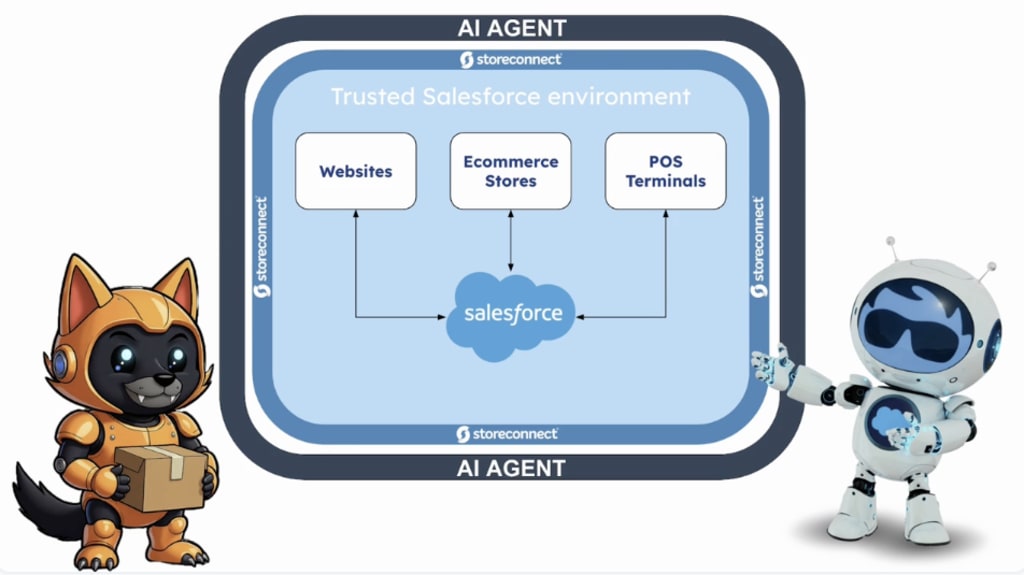
72% of respondents said it is important to know when they are communicating with an AI agent. 46% said they are more likely to use an agent if there is a clear path to a human.
Because StoreConnect is built on Salesforce’s Sales Cloud, and Service Cloud sits in the same system, switching to a human agent just works - no workaround needed.
The recommendation that matters most
The report’s key recommendations point to a single theme: make trust the foundation, not an afterthought. That means clear data policies, transparent AI disclosure, human validation of AI outputs and agent use cases that solve genuine customer pain points rather than simply reduce operational cost.
For StoreConnect users, that translates to a practical starting position.
-
Use Agentic commerce to improve response times and reduce friction. Be explicit with customers when an AI agent is handling their request.
-
Build in a clean handoff to a human for anything complex or high-stakes.
-
And treat the CRM data powering every interaction as a shared asset between the business and the customer, not just an operational input.
The businesses that close the trust gap first will not simply retain more customers. According to the research, they will be the ones customers choose in the first place.
If you’re looking to deploy AI agents that actually build trust rather than erode it, we’re here to help you navigate the shift.
Book a demo with the StoreConnect team to see agentic commerce in action